During my mini-tour of Australia in October 2010 I interviewed Ron Guba in Melbourne. Some of this interview is shown above, in which Ron talks about his use of essential oils to treat very small, early-stage skin cancers or pre-cancerous lesions. These were not cancers that required urgent medical intervention.
The main types of skin cancer include:
- Solar (or actinic) keratosis (a precursor to SCC)
- Squamous celle carcinoma (SCC)
- Basal cell carcinoma (BCC)
- Melanoma
Melanoma (a.k.a. malignant melanoma) is the rarest, but most virulent type of skin cancer. You can find more detailed information on the different types of skin cancer here. Ron believes that “For solar keratoses, or basal and squamous cell carcinomas in early stages, a number of essential oils would be worthy to trial.” This is a trial formula, for 30 grams total:
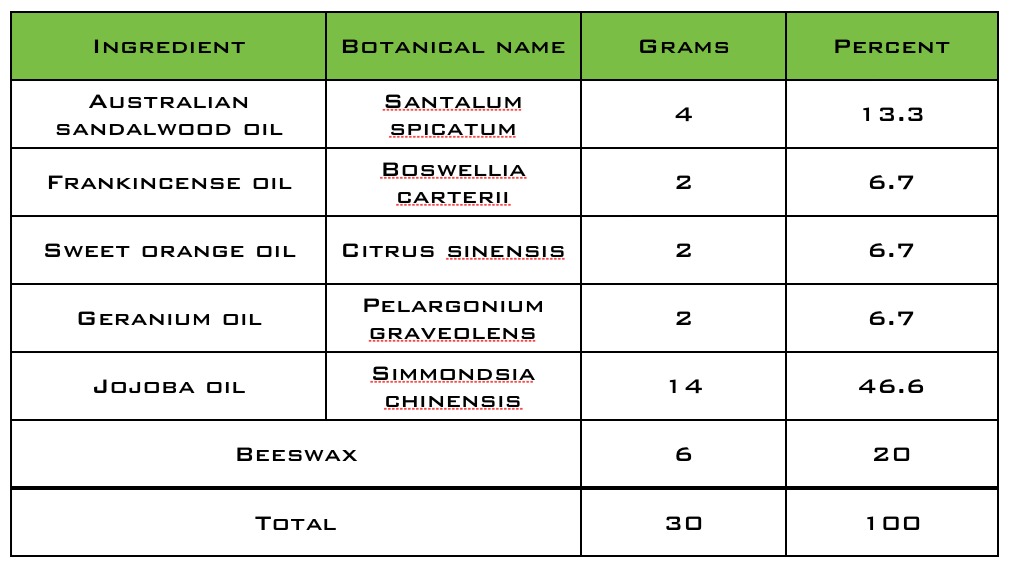
Gently melt the beeswax and Jojoba oil together, then add the essential oils and place into containers to cool. This ointment should be applied to affected areas, two to three times per day. Resolution of lesions can take up to six weeks of daily application. If there is no improvement, discontinue use and seek medical advice.
The two photographs below show the complete resolution of a solar keratosis on a woman’s chest. She used the same formulation as above, but with 50% essential oil. Because of the irritation she experienced, Ron is now using the essential oils at 33%. This is her account of using the formulation: “The second photo doesn’t show it so well but the spot had nearly halved in size, the top half is gone (the photographer didn’t tell me the ruler wasn’t in line!). I can’t notice any remaining mark looking in the mirror but in the final photo there could be the faintest pink mark where it was. I used the oil twice/day. I got some skin irritation after about a week of using it. I considered diluting it but instead applied a little sweet almond oil to the surrounding area when I applied it. The skin irritation resolved after a day or two of doing that. After 2 weeks I noticed part of the keratosis was just disappearing. The rest was completely gone within another 10 days. A very good result considering the skin specialist told me if it was removed it would leave a large white scar.”
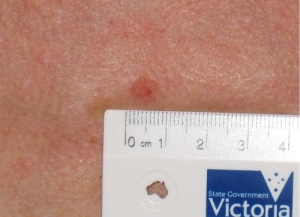
Solar keratosis, day 0
In post-video emails, Ron has added the following information: Another long time aromatherapy friend (a red-head) used the 50% blend on a diagnosed BCC – about 3mm on his upper right chest. Six weeks to full resolution. The two other cases were from afar. One had a small BCC on his right shoulder and reported to me that the lesion had cleared after four weeks. The other had a small SCC arising from an actinic keratosis on his left hand. He had multiple actinic keratoses and had had a number of these removed with cryosurgery and some SCCs were surgically excised. I heard from him some months later that the lesion had healed after ‘some weeks’.
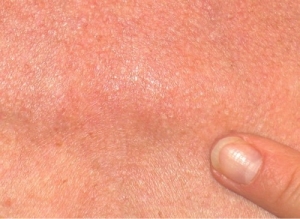
Solar keratosis, day 26
In the end, it is an experimental formula. As I said, it is worthy to trial on small SCCs, BCCs (BCCs being the least risky) and solar keratoses when there is not an immediate need for treatment. If there is no result in six weeks, move on to medical treatment. Part of Elson’s work on ‘exogenous isoprenoids’ were done on melanoma cell lines in vitro and many of the compounds like limonene, geraniol, etc. were effective at arresting growth and inducing apoptosis at low use levels. Of course, it would be interesting to see if such formulae could actually be truly effective on early diagnosed melanomas, but too risky to suggest.
What is great about the essential oil treatment is the lack of pain, and the fact that it does not create a wound with consequent scarring as compared to conventional treatments. I will be making a formula soon for a woman with a small patch of Bowen’s Disease – a pre-cancerous form of squamous carcinoma. I may also extract some powdered frankincense resin with the essential oils, as the boswellic acids in the resin have some useful anti-cancer properties.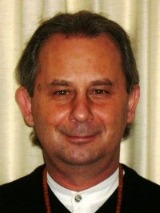
- Ron Guba is Australia’s leading proponent of aromatic medicine, having studied and practiced since the early 1980s.
- Completing his diploma in Phytotherapy and Aromatic Medicine in 1988 in France, Ron began Essential Therapeutics, a company devoted to providing therapeutic-grade essential oils to health practitioners.
- Ron founded the Centre for Aromatic Medicine in 1989, to provide education and training in the practice of aromatic medicine and aromatherapy.
- Ron is a founding member and past chairman of both the International Federation of Aromatherapists (Australia) and the Australian Aromatic Medicine Association. He writes, and lectures extensively in Australia and overseas.
Note
In animal research, experimental skin cancers have been successfully treated with sandalwood oil at 5% (Dwivedi and Abu-Ghazaleh 1997,Dwivedi and Zhang 1999), tea tree oil at 10% (Greay et al 2010).
Dwivedi C, Abu-Ghazaleh A 1997 Chemopreventive effects of sandalwood oil on skin papillomas in mice. European Journal of Cancer Prevention 6:399-401
Dwivedi C, Zhang Y 1999 Sandalwood oil prevent skin tumour development in CD1 mice. European Journal of Cancer Prevention 8:449-455
Greay SJ, Ireland DJ, Kissick HT et al 2010b Inhibition of established subcutaneous murine tumour growth with topical Melaleuca alternifolia (tea tree) oil. Cancer Chemotherapy & Pharmacology 66:1095-1102
Great interview. This CBS news report and slide show from The Skin Cancer Foundation may help identify any anomalies you might find on your body. http://www.cbsnews.com/2300-204_162-10006772.html?tag=page
Great interview! I made a well-researched blend for my daughter after she was diagnosed with cancer. I had already started work on it, but, of course, my “work” became much more urgent. I can’t say that this oil was in any way part of why she was able to be given a clean “no cancer” slate after one year. I can say for sure and certain though that it drastically reduced the size of an actinic keratosis I had on my left calf that had been an embarrassment to me for years. It had become bigger and more crusted over. It now is just a slight non-raised discoloration probably 1/10 of the size it was. I was just experimenting since the blend I made for my daughter was based mostly with going at it from the assumption that cancer is a virus. I didn’t think to take before and after pictures and if I had, I would certainly have submitted it to AIA’s database. But, it is very good to have interviews such as this one to give credibility to the fact that essential oils do work and work well.
Hi Ann.
I found your comment interesting. I believe that viruses are the fundamental cause of tumor formation. I made a keratoacanthoma on my face. It was removed and the pathologist said it was because of the sun. But reading a book that used to query the quote about Masters had human papilloma virus (HPV).
Look:Human Papilloma Virus Infection: A Clinical Atlas /Ullstein Mosby GmbH & Co, KG, Berlin/ Wiesbaden, 1997. ISBN 3-86126-117-0. In portuguese: Infecção Por Papilomavírus Humano – Atlas Clínico de HPV.BARRASSO, Renzo, GROSS, Gerd. ARTMED, Porto Alegre, 1999.
Best Regards. Elisabeth Casagrande
I’ve had success removing actinic keratosis lesions with a strong dilution of Boswellia carterii, per Dr. Raphael d’Angelo’s suggestion. Thank you for posting this, Robert.
Wow! Terrific interview. I have to say I am very intrigued by this research and really look forward to it and the results it produces as well as more studies on this. Thank you.
I tried to make the recipe in the article but the beeswax jojoba combo made it as hard as a chapstick (lip balm). I haven’t added in the EOils yet, but I don’t think they could soften it up that much. The article says ointment, which I think of as being much softer than chapstick. Should I add more jojoba? Divide the beeswax/jojoba then add essential oils? Do you use finger to apply like lipbalm or small spatula. I’m trying to help my sister. Thanks for any help you can give, Kim
Hi Kim, the EO percentage is quite high, so will make the final ointment softer, but if it’s still a bit hard just use a little less beeswax and a little more jojoba.
Very useful article! It is great to know there is possible to treat early signs of skin cancer with other that medicines. Even though it’s not always working and most of it is in experimental phase I am very hopeful this will change. I find the video very informative, and hope many people will try and benefit from what nature has to give.
Hi,
Would this blend work for benign skin tumors too? I am referring specifically to syringomas, which are benign skin tumors found around the eyes. Thank you.
Thank you for your question Lynda. I think Ron Guba’s formulation would be too strong to use close to the eyes. It is possible that a 5% concentration of essential oils might be helpful, but I am not aware of any evidence relating to syringomas.
Hi, I just began using this protocol 5 days ago. I have a Actinic Keratosis on my chest area. I have had it removed once. Then it grew back. Then my dermatologist froze it and it fell off. Now it has grown back a second time. My question is, is it common for it to itch. It hurts and itches at the same time. I am wondering if this is just the healing process from the oils? There is no other irritation with it. Thank you for the info.
Hi. I am trying to find a lotion I can use to stop keratosis pilaris. I can not use bees wax due to allergy to propolis, as it sometimes contains small amounts.
I am a little unsure about the amounts in the above mixture you described, and then there is descriptions of percentages used.
Last, I was wondering if this can be a deficiency in vitamin A? Someone made a comment that made since that this could be a contributor. Can you please help me with this? I would be very thankful.
Oh, and I am allergic to tea tree oil.
Thanks.
Hi Valinda, there’s no reason to believe that Ron’s formulation for actinic keratosis would be helpful for keratosis pilaris (KP), as they are very different conditions. You can read about KP herehttp://www.ncbi.nlm.nih.gov/pubmedhealth/PMH0002433/ KP is very common but difficult to treat, and I am not aware of any essential oils that might help. The most common treatments include keratolytics such as salicylic acid or retinoids. KP is not thought be to related to vit A deficiency.
Hi Robert and Ron,
I am very interested in the 6 ingredients that you have posted in regards to treating several different types of skin cancers and Keratosis. I would like to purchase all these ingredients and make this up. Could you give me any suggestions on where to purchase all of these and how much this makes so that I can begin to use it and be a witness to the results for all of my pre cancerous spots on my face. Could you help me out with getting started in all these products? Thanks so much and look forward to hearing from you.
Hi Debra,
Here are some suggestions for essential oil sources:
Aliksir http://www.aliksir.com/
A Little Ol’Factory http://alittleolfactory.com
Aromaceuticals http://www.aromaceuticals.com/
Aromatics International http://www.aromaticsinternational.com/
Eden Botanicals http://www.edenbotanicals.com/
Enfleurage http://www.enfleurage.com
Morning Myst Botanics http://www.morningmystbotanics.com
Nature’s Gift http://www.naturesgift.com/
Stillpoint Aromatics http://www.stillpointaromatics.com/
SunRose Aromatics http://www.sunrosearomatics.com/
The Essential Oil Company http://www.essentialoil.com/
White Lotus Aromatics http://www.whitelotusaromatics.com/
Hi, I have Keratosis on a large proportion of my back. It began when I was in my mid 20’s. Im now 55. My gp says there is nothing that can be done. would your formula help me.
Hi Jane, there are a few types of keratosis. If yours is actinic keratosis, then this is exactly what Ron Guba’s formulation is for ,but it may help with other types too.
Hi,
I have multiple actinic keratoses on my face and nose which my dermatologist ‘burnt’ to remove but said that i’d have to have a ‘chemical peel’ to further treatment as a lot of damage had been done. I found this page whilst searching for an alternative treatment that seemed to make sense and followed the instructions and have used the ‘ointment’ for 6 weeks. The results have been pretty subtle….my skin feels a lot better/smoother and less dry after the ointment but the multiple actinic keratoses have not dissapeared. As Ron Guba says above it’s an experimental treatment which whilst not successful in my case had no side effects bar the positive one mentioned above.
Could you possibly translate grams to drops for me?
Thanks
Carey
Carey, there are approximately 30 drops to 1 gram.
Hi, how come that there is Citrus Sinensis in Ron’s mixture as there is a photo sensitive issue with most of citrus and in this case with aurapene, bergaptol, iso-imperatorin? I would have thought that using citrus on the skin was not recommended? What do you think?
Hi Isabelle, Citrus sinensis (sweet orange) is one of the citrus fruit oils that is not phototoxic. The essential oil contains no furanocoumarins at all, so there is zero risk of a phototoxic reaction.
Thank you for your answer Robert. I thought auraptene, bergaptol and iso-imperatorin were classified by Franchomme under coumarins/ furanocoumarins and therefore phototoxic. How can French and American views be so different?
Yes, they are all furanocoumarins. Auraptene is found in some citrus fruit, but not in any essential oils. Bergaptol is found at up to 0.2% in bergamot oil, but it is not phototoxic. Isoimperatorin can be found in trace amounts in lemon oil, and is weakly phototoxic. None of these is present in Citrus sinensis expressed oil. Perhaps the difference is due to the Franchomme & Penoel book having been written 23 years ago, when less was known on the subject. The fact that none of the text is referenced makes it difficult to know from where information was derived.
Thanks a lot for your input. All is clear now 😉
Dear Ron Guba (or Robert), I cant believe that there i was researching Decubitus ulcers and came across the following heading..”Wound healing A pilot study using an essential oil-based cream to heal dermal wounds and ulcers” and would like to know if I might get a copy of this article. My mentor Dr Nye (you may know her) recently presented us with a case study on this very subject and I am doing a follow up research to present to our local chapter of the AromaSA and also which I am hoping is thorough enough I could present a talk to the “powers that be” in National Health care to see if we cannot find a place in the system to serve in complement to care.
Regards
Andrew
Is there anywhere to buy this mixture already made to use?
I don’t think so Helen.
Hello, I spent my childhood on the beaches of Australia – no sunscreens – I am 66. I have lived in the UK for many years, though I did buy E.O’s from Ron Guba’s company in Collingwood, Melbourne in the early 1990’s. I have developed keratosis, both solar & what was called ‘senile’ on my torso & neck. Not having found anything before prior to this post I did some research a couple of years ago & found that Celandine oil was used in Russia. I could only buy this through a friend who lived in Latvia. I found massaging the keratoses daily, after a bath, was enough to remove the solar k’s in one month. The ‘senile’ ones have faded considerably, but have not yet vanished. Could I add the essential oils in Ron’s formula to the Celandine oil? It is either a macerated or infused oil. I do wish we were able to access other countries traditions more easily. I have a book on aromatherapy written in French, translated to English & I am fascinated at the different ideas on the usage of EO’s. I do think we in the English speaking world are quite conservative. Thank you very much for your interview with Ron. I am pleased to hear he is working on healing. It just needs the medical profession to realize we are all trying to help people, not compete with each other.
Hi Toni, thank you for your comments! And yes, you could add the EOs in Ron’s formula to Celandine oil.
Hello,
Unfortunately I have had several squamous cell carcinomas excised in past few years. Two within the past two weeks. Recently introduced to EO’s I have been using them for the healing of the incisions. I was wondering if a mixture of the mentioned EO can be used on a daily basis to prevent the forming of the carcinomas?
Hi Tamara, I’m sorry to hear about your skin cancers. The above formulation uses 33% essential oil. For daily prevention, I would suggest a 5% dilution.
Hello,
I was wondering what the amount in grams translates to in terms of drops of each oil? I trying to find an easy way of measuring the oils and I’m not sure how to measure them in grams .
Thanks!
I will preface this question by stating that I am very new to essential oils. I plan on making this ointment for a few concerning places on my skin. I have read elsewhere that Boswellia carterii’s strength to treat cancerous conditions lies in the resin. It was also stated that steam distilled B.c. does not contain any of that resin. It would appear that CO2 extraction does contain the resin but you have stated in a blog post Q&A that CO2 extraction is not a true essential oil. So now I am confused! For this ointment, will the steam distilled B.c. be sufficient or should I purchase a CO2 extraction?
In addition to Ron Guba’s formulation here, there is some evidence – a single case study – that frankincense oil may be helpful in skin cancer. The EO does not contain boswellic acids (BA), which have been very widely researched for its antitumoral effects. Nor does the CO2 extract. Frankincense – the raw gum resin – contains about 40% BA. There may be commercially produced extracts with high BA content.
Thank you for your response! There is so much to learn – I plan to order the second edition of Essential Oil Safety soon!!
Fascinating information. I’m so delighted I came across this today. Thank you both ron and robert.
Would Geranium Egyptian or Geranium Bourbon be reasonable substitutes for the species of geranium listed in Ron’s formula?
Hi Jennifer, yes they would I presume you’re asking because of the difference in botanical name. To cut a long story short, they are in fact the same species.